
Jonathan Hanbury, Clinical Lead and Founder of The Ness Care Group, explains why neuroplasticity influences the way Ness approaches dementia therapy.
I recently watched an excellent TEDx talk by Dr Lara Boyd on neuroplasticity within stroke rehabilitation and what struck me was the similarities between dementia treatment and stroke rehabilitation.
Before someone calls me out, I am aware that dementia and strokes are very different. Dementia is a progressive neurodegenerative condition with no current cure, while stroke rehabilitation aims to help the brain recover, adapt and make the best use of the function that remains.
That said, I strongly believe that dementia treatment should, like stroke rehabilitation, have its foundations in neuroplasticity.
What is neuroplasticity?
Neuroplasticity is the brain’s ability to change and adapt. It is sometimes described more simply as having a ‘plastic brain’, although the science behind it can quickly become complex.
Modern science recognises that all human brains are made up of billions of neurons connected through networks of neural pathways.
These networks are constantly changing. Some connections may weaken if they are not used, while others can be strengthened or created as we learn new skills and experience new things.
This adaptive quality of the brain is called neuroplasticity. It allows our brains to take in new information and use our experiences as efficiently as possible.
If the brain is damaged, it may also be able to adapt, form alternative pathways and find different ways of carrying out some functions.
I am going to leave the explanation at that simple definition, but there is a huge amount of research into neuroplasticity and how our brains can adapt following injury or disease. I have included a link to a short video below for anyone who would like to explore it further.
What does neuroplasticity mean for dementia?
Neuroplasticity means that although dementia damages the brain and its neural pathways, the brain may still retain some capacity to adapt and respond to activity, repetition and stimulation.
Dementia is an umbrella term for a number of neurodegenerative conditions, including Alzheimer’s disease and vascular dementia.
These conditions affect the brain in different ways, but they can all cause damage to the neural pathways mentioned above. Over time, this may cause loss of memory, loss of function and increasing difficulty managing complex tasks.
However, the progression of dementia is not the same for every individual. People continue to retain different skills, memories and abilities, and the brain can still respond to activity, repetition and stimulation despite dementia.
By maintaining brain stimulation, encouraging social connection and repeating meaningful actions, we can give the brain ongoing opportunities to use and reinforce the connections that remain.
At The Ness, we sometimes describe the repetition of meaningful actions, routines and stimuli as ‘memory stamping’. Repetition can help reinforce learning, familiarity and retained abilities.
This understanding of neuroplasticity lies behind Cognitive Stimulation Therapy, reminiscence therapy, cognitive rehabilitation, creative therapy and many other stimulating therapeutic approaches.
How does Cognitive Stimulation Therapy support brain activity?
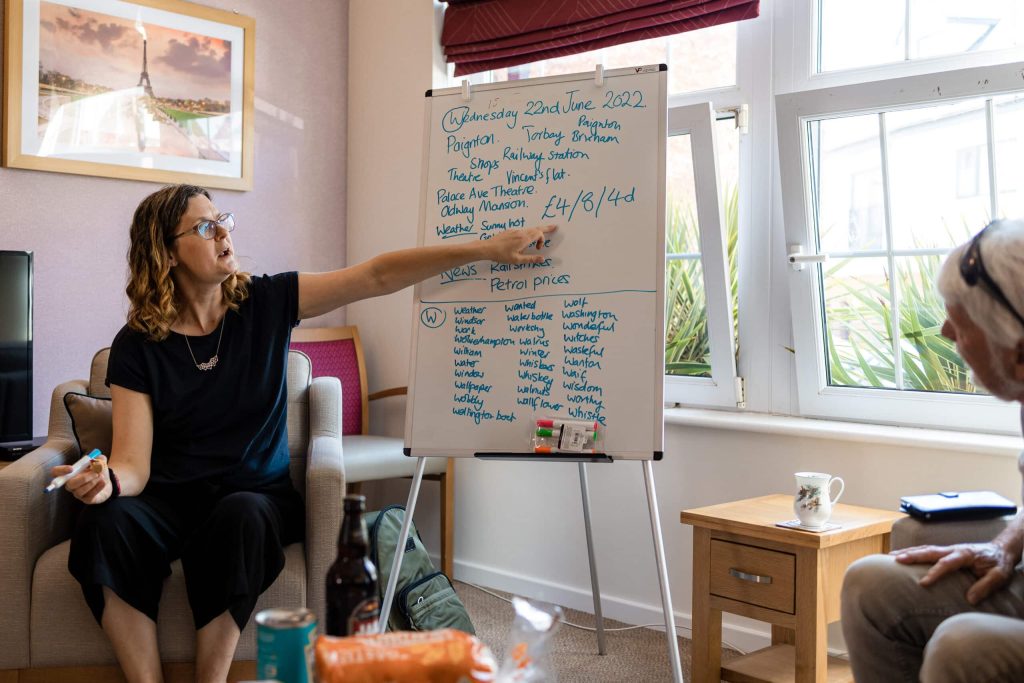
Cognitive Stimulation Therapy supports brain activity by using conversation, social interaction, repetition and enjoyable activities to engage different cognitive abilities.
The good news is that this isn’t school.
For people living with dementia, there is no expectation that they should spend hours learning a new language or practising maths to improve their brain.
We are social animals, designed to learn from each other. Our brains respond to conversation, movement, emotion, activity and connection.
Cognitive Stimulation Therapy takes into account social learning and connection, repetition and routine, while also concentrating on specific cognitive abilities such as language, facial recognition, numbers, planning and completing more complex tasks.
Importantly, it makes this enjoyable.
Behind the scenes, a skilled facilitator is using Cognitive Stimulation Therapy to engage different cognitive abilities and help a person continue using the brain function they still have.
A session may look like a conversation, a game, a creative activity or a group discussion. However, a good facilitator should understand why the activity has been chosen, which abilities it is intended to engage and how it should be adapted for the people taking part.
Why does social connection matter?
Social connection matters because conversation and shared activity give people regular opportunities to use language, memory, attention and other cognitive abilities.
Following a dementia diagnosis, some individuals and families become more isolated. A person may lose confidence, stop attending social groups or spend more time at home, perhaps with only their partner or the television for company and stimulation.
We should not suggest that isolation alone determines how quickly dementia will progress. Dementia is far more complex than that.
However, less conversation, activity, movement and social interaction can mean fewer opportunities to use the abilities and connections the brain still has.
Television can be enjoyable, but it is largely passive. A conversation requires someone to listen, process information, interpret another person’s expression, remember what has been said, find words and wait for their turn to respond.
That is a considerable amount of brain activity within one ordinary human interaction.
Why should a diagnosis not be the end of treatment?
A dementia diagnosis should be followed by treatment, cognitive stimulation, meaningful activity and practical support, not simply information about future decline.
There is no cure for dementia. There is no pill that can currently reverse the disease.
But equally, we should not ignore the amazing piece of equipment that sits between our ears.
A diagnosis should be followed by access to cognitive stimulation, meaningful activity and encouragement from doctors, nurses and other professionals to seek out suitable groups.
People should be helped to remain active, social and involved in their own lives for as long as possible.
Cognitive Stimulation Therapy should not be viewed simply as something pleasant to fill the time. It is a recognised treatment for people living with mild to moderate dementia and should form part of the support offered following diagnosis.
How does The Ness Care Group use neuroplasticity in practice?
At The Ness, we apply the principles of neuroplasticity through structured cognitive activity designed to help people continue using their memories, abilities and brain function.
Our sessions are social and enjoyable, but they also have a therapeutic purpose.
We think about language, working memory, planning, recognition, movement, attention and social confidence. We consider what each person can do, what they would like to maintain and how activities can be adapted as their needs change.
We cannot cure dementia, and we should never suggest that we can.
What structured cognitive treatment can do is help people continue using their abilities, maintain cognitive function, support communication and confidence, and remain engaged in daily life for longer.
That is why neuroplasticity matters, and why it sits at the heart of the way we work at The Ness.
Watch the talk
After watching this, your brain will not be the same
Dr Lara Boyd, TEDxVancouver